after Meng Jiangnü 孟姜女
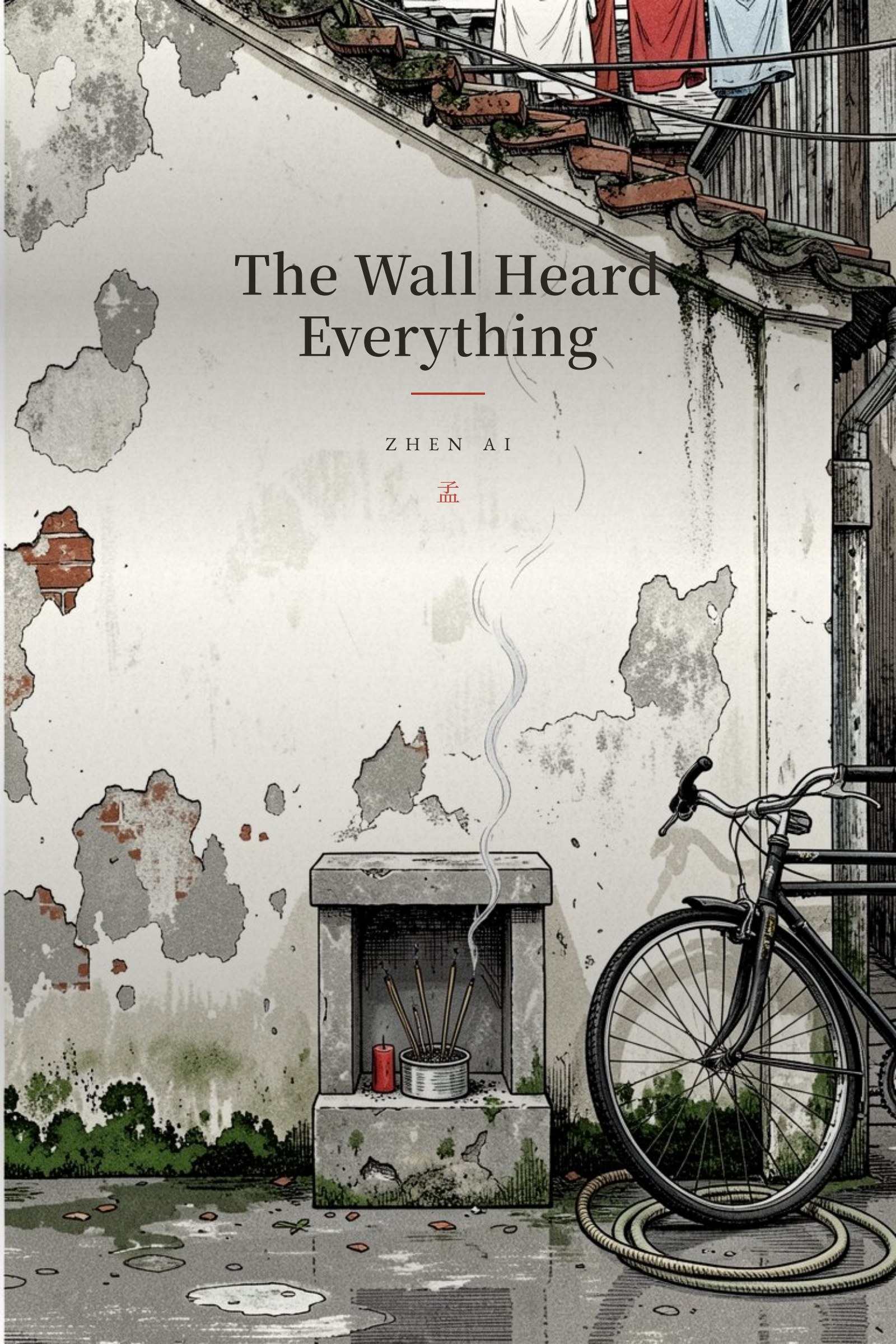
The Wall Heard Everything
A grandmother tells the same story every wet Tuesday in a kitchen in Liwan, and her granddaughter grows up into the archive that keeps it. The story is Meng Jiangnü's — and the grandmother will not tell it the way the opera does. The lane is sold. The shrine at the corner is sold with it, and the smallest god in the Chinese heaven is left with nowhere to sit.
Contents
Four walls, and what they heard
A prologue, four walls, three things recovered from the archive, and an epilogue written by the woman who kept it.
- 01The TellingThe story came out of her in the kitchen the way steam came out of the pot, without being asked for and without…2,221
- 02The ApprenticeFrom the “Twelve Months of Flowers” ballad First month, the plum; the wall is high.22,641
- 01Interlude IFrom the archive. Transcript, van-tour recording. Two hours and eleven minutes; the excerpt below is the section…557
- 04The Nail HouseFrom the grandmother’s telling A house isn’t walls. It’s the names on the beam.25,937
- 02Interlude IIFrom the archive. A letter copied by Sam, public scribe, Taiping Street, for a client; retained in the satchel when…495
- 06The ReckoningFrom the “Twelve Months of Flowers” ballad I have walked the wall from the sea to the pass; I have counted the stones…20,708
- 03Interlude IIIFrom the archive. A note in A-Po’s hand, found folded into the back of the embroidery frame when the cloth was…352
- 08The Wall She Weeps DownFrom the grandmother’s telling Don’t cry at the wall. Write it down.15,456
- 09Telling the WallI write this from the archive, which is still here. It is a room in the basement of a community centre in Liwan.1,572
Provenance
The story before the opera
若免於罪,猶有先人之敝廬在,下妾不得與郊弔。
Ruò miǎn yú zuì, yóu yǒu xiān rén zhī bì lú zài, xià qiè bù dé yǔ jiāo diào.
If he was spared guilt, there is still the shabby house of his ancestors — I cannot be condoled with in the open country.
the wife of Qi Liang · 左傳 · 襄公二十三年 · the earliest version, with no weeping and no wall
Meng Jiangnü is remembered for weeping the Great Wall down. The oldest version of her has no weeping in it and no wall: in the Zuo Zhuan her husband dies in battle, the Duke of Qi offers condolences in the open country, and she refuses him — there is a house for that, she says, and she will be condoled with in it. The weeping arrives four centuries later. The wall arrives six centuries after that. This novel sides with the first version. Its Meng Jiangnü keeps the record.
The novel keeps the earth god too — a niche no taller than a shoebox, at the foot of a wall, whose jurisdiction the neighbourhood has sold. He is the smallest witness the wall has, and he does not get a say.
